
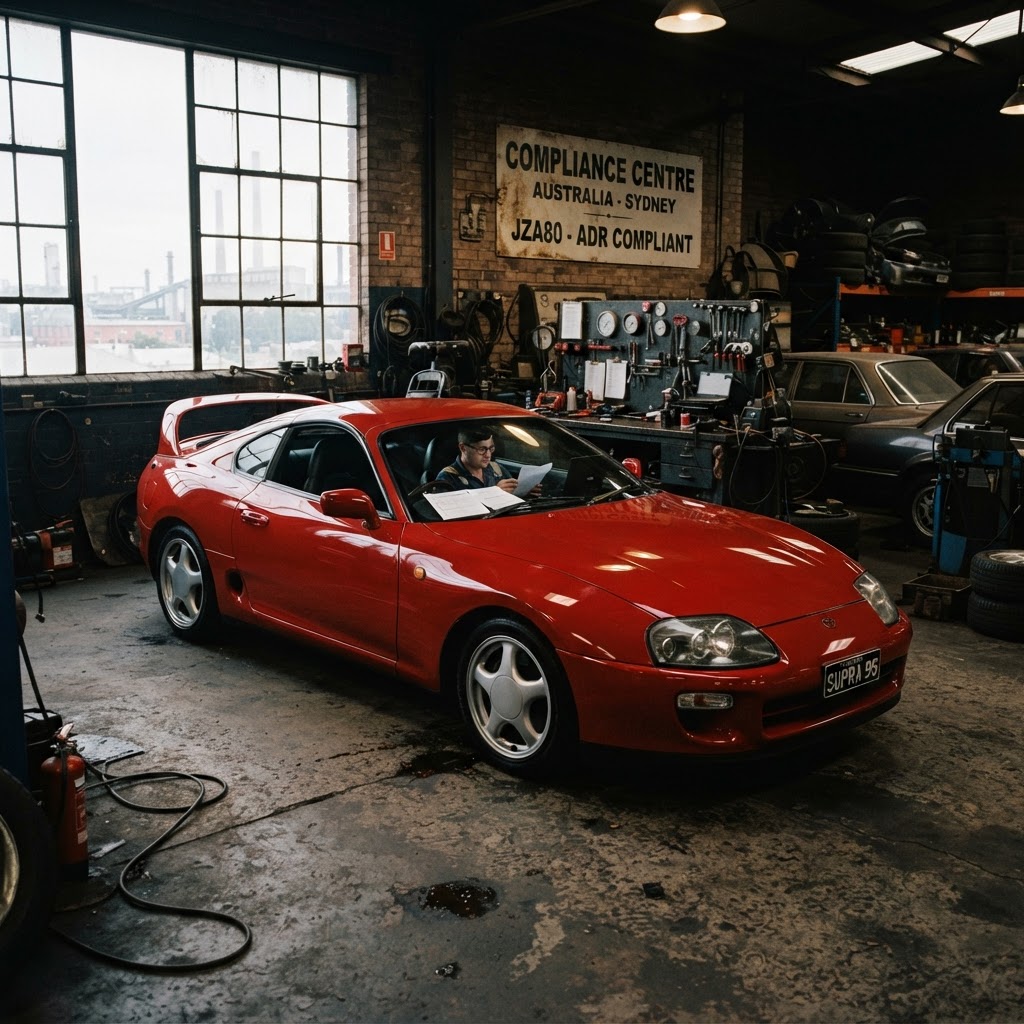
Australia does not allow every Japanese car to be imported. A vehicle has to qualify under one of a small number of entry pathways, and the pathway determines how (and whether) it can be complied and registered. If you are shopping for a JDM car, it helps to understand these rules — because every vehicle we sell has already cleared them.
SEVS — the Specialist and Enthusiast Vehicle Scheme
The Specialist and Enthusiast Vehicle Scheme (SEVS) is the main route for importing a late-model Japanese vehicle that was never sold new in Australia. To qualify under SEVS, a vehicle must meet at least one of several criteria designed to identify cars that have genuine enthusiast appeal or a technical point of difference:
- Performance — a high power-to-weight ratio.
- Rarity — low-volume production numbers.
- Unusual features — a configuration not available on locally-delivered models.
- Enthusiast demand — recognised enthusiast backing.
The federal government publishes the list of vehicles that have been granted SEVS eligibility. Only those listed can enter as a SEVS import. Because the list is set by regulation, it changes over time — vehicles are added and occasionally removed as the market shifts.
The per-model, per-year volume cap
SEVS vehicles are subject to a volume cap. Once a certain number of a given model have been imported under SEVS in a calendar year, no more can enter until the next year. This keeps the scheme focused on genuine enthusiasts rather than volume importers.
The Register of Approved Vehicles (RAV)
Since 2021, every road vehicle first entering Australia must be listed on the Register of Approved Vehicles (RAV) — the federal database that replaced the old compliance-plate system. For an imported used vehicle, a Registered Automotive Workshop (RAW) with the correct approval must:
- Fit the required ADR modifications.
- Issue a Used Import Plate (the RAV plate).
- Upload the vehicle's details to the RAV.
The RAV entry is the car's federal identity. Without it, no state will register the vehicle. Every car we sell carries its RAV plate and a valid RAV entry — that is what "complied" means on our listings.
The 25-year rule (the pre-1989 pathway)
There is a separate pathway for genuinely classic vehicles. A vehicle manufactured more than 25 years ago can sometimes enter under different concessions that recognise its age and rarity, rather than requiring SEVS eligibility. This is the route for landmark JDM cars — early Skyline GT-Rs, original Mazda RX-7s, kei sports cars, and the like.
Because the 25-year window moves forward each year, newly-eligible models come onto the market on a rolling basis. We track these windows closely so that when a model crosses the threshold, we are positioned to source the best examples.
Locally delivered vehicles
Not every car we sell is an import. We also retail locally delivered vehicles — Japanese and other marques originally sold new in Australia. These carry the original manufacturer's compliance plate and need no import or SEVS pathway at all. They appear in our inventory with the source type "Locally Delivered".
What this means for you as a buyer
You do not need to navigate any of this. Every vehicle in our inventory has already cleared its import pathway and carries its RAV plate or original compliance. Your only job is to choose the car, arrange finance if you need it, and drive it away.
If you are researching a specific model and wondering whether it can be brought in, the answer is almost certainly in our current stock — and if it is not, tell us what you are after and we will let you know honestly whether the vehicle is eligible.
Find your next vehicle
Every car we retail is complied, documented, and ready to register. Browse the current collection.
View Inventory